


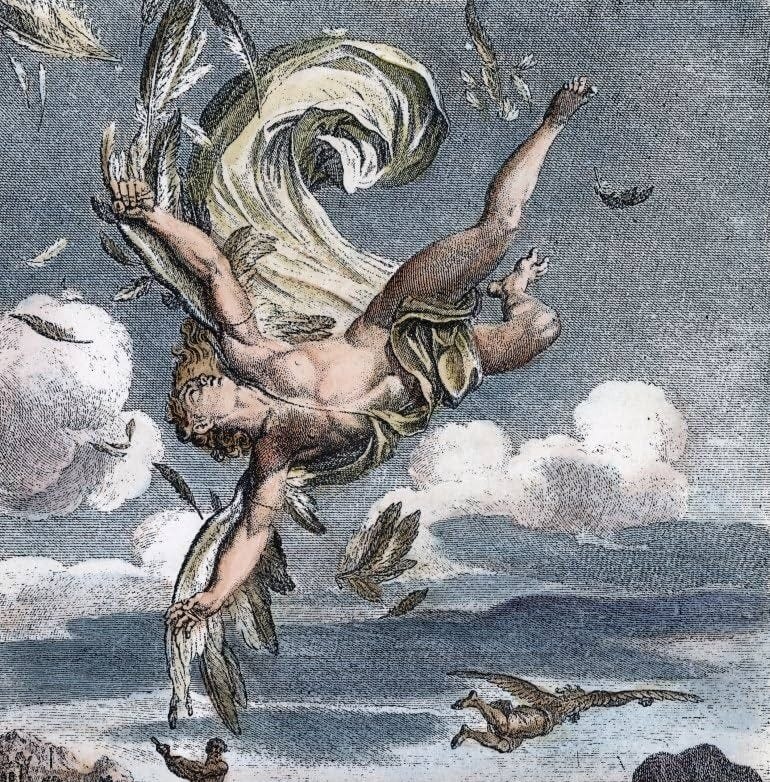
Now that you know how cryptonarratives work, I’m going to give you a new one for Icarus. This one is my own! I have uncovered a cryptonarrative in this famous myth, which I’ll share with you now.
It’s widely known that Icarus, son of the inventor Daedalus, took the wing-suit invented by his father and flew with it. Daedalus warned him not to fly too close to the sun, or the wax that bind the wings he wore would melt.
The Story We’ve Been Told!
In the traditional narrative, Icarus ignored his father’s warnings, soaring too high into the sky. The wax melted, and he plunged into the sea and drowned.
“Don’t fly too close to the sea, or the feathers will soak and become heavy, and don’t fly too close to the sun, or the wax that holds the feathers together will melt.”
As we all know, flying too close to the sun is an idiom for exhibiting too much pride, leading to one’s social downfall. We use it today when someone’s gotten too big for their britches, or when they overestimated their own power and capacity. This is all fine and dandy, healthy and useful. The Icarus story works well to warn us of the folly in pride and the pitfalls of audacity.
But wait a minute! In reality, the higher we fly, the colder it gets, right?
You don’t have to have airplanes to know this. Even in the ancient world, people found that with higher elevation came colder temperatures.
Did people not climb mountains in ancient Greece? What about Mount Olympus?
So why was Daedalus concerned about heat? Perhaps Daedalus, the great inventor, believed that the sun was floating in the earth’s atmosphere and a field of extreme heat surrounded it, but only for those who got too close to it. The ancient Greeks didn’t adopt the heliocentric model of the universe. The Arabs later conducted the astronomical studies that lead to Galileo’s establishment of the heliocentric model in the 16th century.
Myth and Science
When the mythical Icarus flew high into the sky, did he encounter hotter temperatures or much colder ones? In my counternarrative, Icarus learns the truth of the heavenly bodies. No matter how high Icarus flew, the sun was still far away from him, and temperatures only got colder. So he was never in violation of his father’s directives. Eventually, it got so cold that the wax became brittle and rigid. The wax almost froze, and without its flexible properties, it cracked and broke as the wings and feathers moved. So it was the extreme cold of higher elevations, not heat, that would make the wings disintegrate and have Icarus plunge into the sea.
Icarus didn’t do anything wrong because he was warned about heat, not cold, and everyone just assumed that his wings melted because he got too close to the sun. Since he fell into the sea, the wing-suit couldn’t be examined for signs of melting. The truth of the natural world died with Icarus. Only he knew that the sun wasn’t in the Earth’s atmosphere. He knew that no matter how high he flew, he would never get close to the sun. And only he knows that the cold is the real threat to Daedalus’ wing-suit.
I’d argue that all three of these morsels of knowledge are incredibly valuable. The sun isn’t in the earth’s atmosphere, high elevations are extremely cold, and cold is detrimental to the wax that binds the feathers. All of these valuable secrets die with Icarus.
Icarus’ Cyptonarrative
Only he who has fallen knows the truth of his undoing. All the rest will make up stories that suit their perspective, filling in the blanks with made up details. They weren’t there with one who flew, so they can’t know the truth. When you fly high, it might be your undoing, but you’ll gain lessons about the nature of reality that only you may come to understand. Even if it sends you crashing down to earth, you’ll gain knowledge of unequaled value.
In the case of the myth of Icarus, the dead can’t speak, so the people of his town couldn’t learn what he’d seen. But, when there’s a modern fall from grace, we can find out what the fallen have learned.
When a person’s pride gets the best of them, or their addiction makes them hit bottom, or a political leader has a scandal and loses high standing in society, none of it’s fatal! We can still talk to these people and hear what they’ve learned.
If we can take anything from Icarus’s cryptonarrative, it’s that we should talk to those who’ve fallen from grace, and mine their stories for some nuggets of insight. Within their stories are great lessons about human nature, and we can learn so much from them on how to prevent such a case from happening again.
We do this all the time with murderers. We love putting every detail of their lives under the microscope to glimpse a few bezels of wisdom. But we’re still afraid to do this with other types of violators of social mores, like sex addicts and other “deviants”. So let’s start talking to them! Let’s talk to all the perverts, pedophiles, cheaters, porn addicts, and philanders, and let’s definitely start talking to the porn-stars and prostitutes too! (Apparently a lot of p-words are used to label people we don’t want to talk to because they’re involved in sex stuff.)
I want to talk to them! Or rather, I want you to talk to them, and I want people to hear what they have to say!
Icarus’ cryptonarrative is that we don’t really know how the fallen fell, until we talk to them, and if we can get the truth straight from the horse’s mouth, we ought to! It’s better than shutting the door on those who’ve fallen from grace. When someone has a great fall, it’s an opportunity for the rest of us to learn. We need to know how people and things got the way that they got, and we need to hear their stories. Use those people to learn what’s really going on in society, and what needs to change!
I’ve got one more thing to say on this topic…
